OneBus Fleet Insight

Your next bus decision,
on your own service.

A consultant-grade fleet assessment built from the data you already have. In less than two weeks it gives you valuable insights into your operation and tells you which vehicles can run your service as you actually run it, what each option costs a year, the fleet mix that costs the least, and your zero-emission possibilities for a fraction of what your last transition plan cost.

1 Export
An APC export is all we need from you. No surveys, no hard-to-find spreadsheets, no consultant on site
2 Weeks
From receipt of your data to assessment delivery, including a login to your interactive platform and the full downloadable report
~1/10
The cost of a conventional fleet transition plan
Every Number
Tagged Measured, Modeled, or Reported, with its value and source

Three questions your board,
your state DOT, and the FTA already ask.

01

How much vehicle do we actually need?

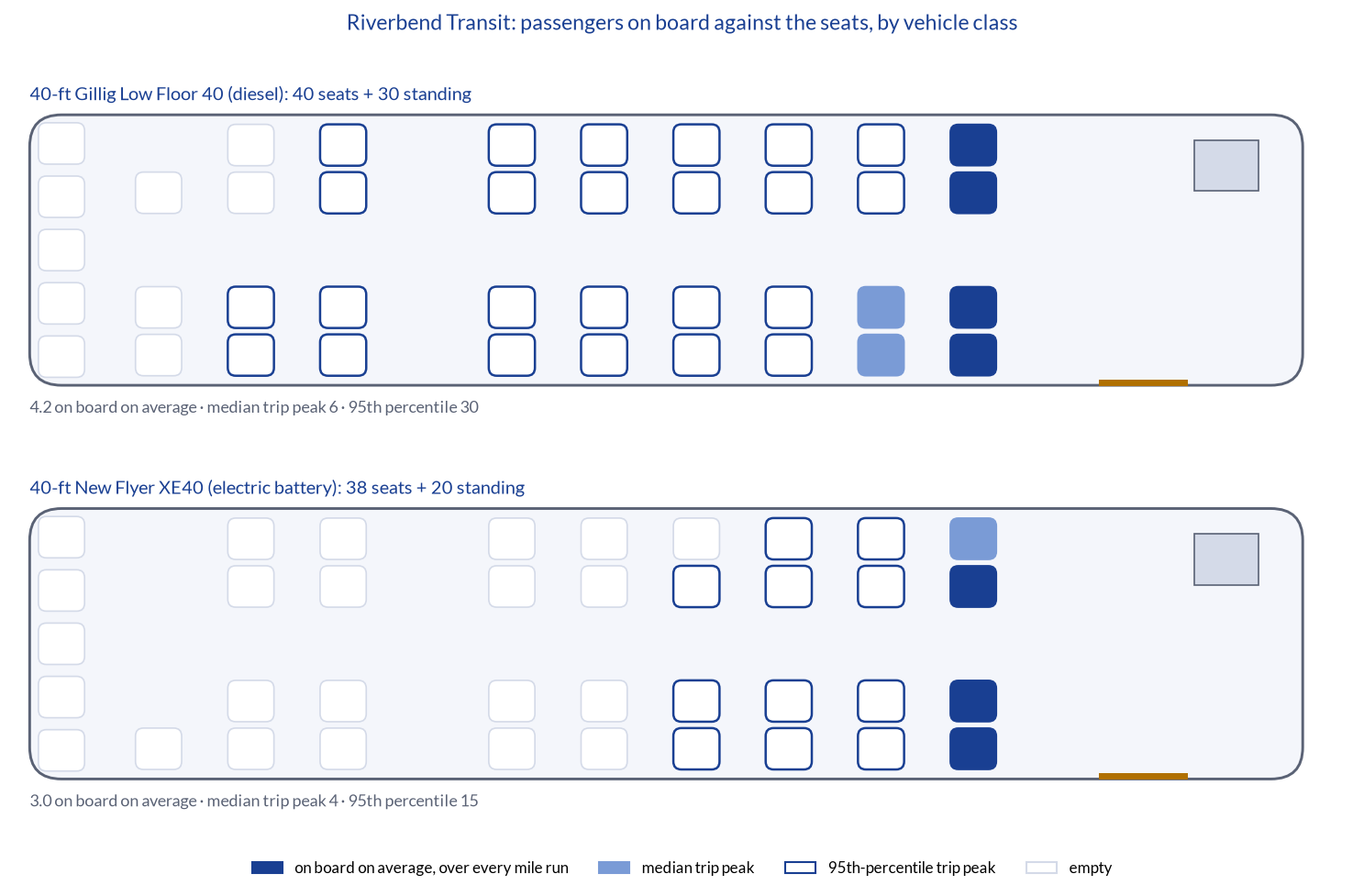
Passenger loads measured on every block-day you ran, against the seats you paid for. Are you paying more to move the bus than to move your passengers? The seat map alone usually settles the over-capacity question in one glance.

02

Which vehicles can run our service as we run it?

Every candidate vehicle is run over every vehicle-day in your record, chained blocks and deadhead included, in your climate and on your terrain. Side-by-side with the overcapacity assessment, you see the share of days each vehicle completes and the days it does not.

03

What does each option cost?

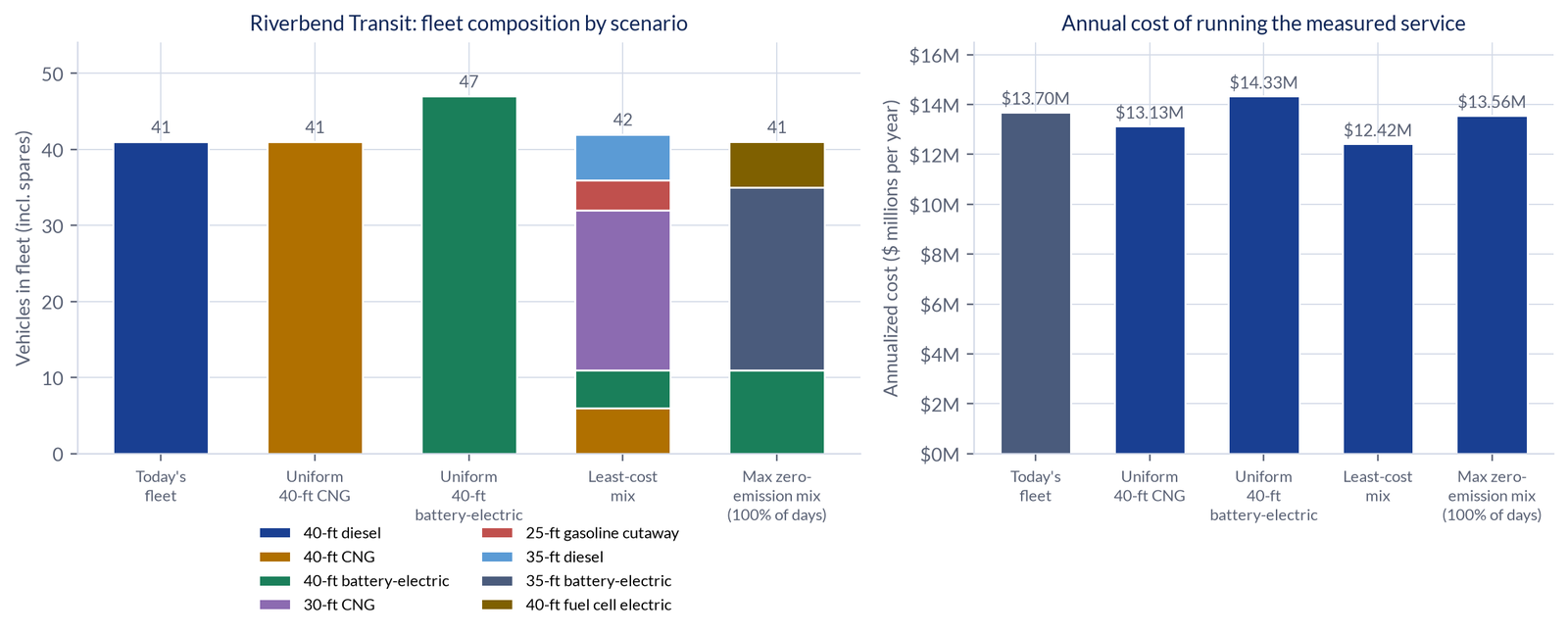
Capital, energy, and operating cost per year for each candidate, and the fleet mix that costs the least within your loading standard. In the demonstration study, the optimizer finds savings a like-for-like replacement leaves on the table.

A method you can trust,
not a binder you file.

Fleet Insight is sold as a platform-hosted simulation study. You buy the answers. The engine behind the answer is the reason the studies arrive in days instead of months, costs a fraction of a traditional consultant's plan, and carries repeatable accuracy.

Step 1

You already have the data

Provide a stop-level APC export. We bring the rest: terrain, elevation, weather history, published vehicle specifications, embedded bus and industry expertise, on top of your own public data filings.

Partial APC coverage is fine. Data gates flag block-days the counters missed or doubled and exclude them from load statistics while keeping them for miles and energy modeling.
Step 2

Calibrated to your own filing

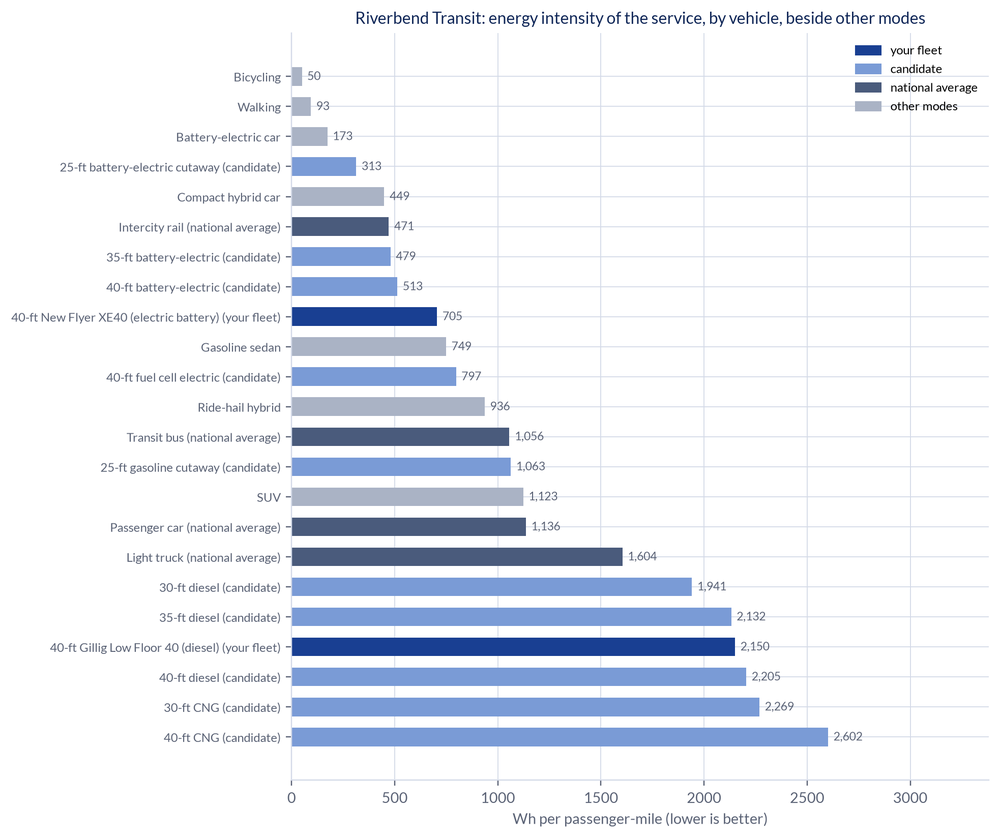
The energy model is fitted to the fuel and electricity you've reported. If you run any electric vehicles, we predict their consumption without looking at it and show you the comparison.

Demonstration study: 9.11 kWh/mi modeled against 9.18 kWh/mi reported.
Step 3

Range and passenger capacity tested on your vehicle-days

Each candidate is run over every day a vehicle actually did, with chained blocks, deadhead, ambient temperature, and grade. The result is a completion rate per vehicle, not a range claim.

Physics-based energy model · Vehicle-day simulation · Passenger loading from predictive analytics
Step 4

Fleet mix optimization

One vehicle class is assigned to each vehicle-day on your schedule as run, within your loading standard and range requirements. The uniform-fleet, the least-cost mix, and the maximum zero-emission fleet mix are all shown side by side so the difference is visible.

Respects today's block chains · Capital and operating cost break downs per option
Step 5

A living study, not a snapshot

Every assumption is named with its value and its source. Confirm a tariff, send a winter export, add a candidate vehicle, and the whole study regenerates in an hour or so. A plan written two years ago is wrong today; this one does not have to be.

Comprehensive Report · Executive summary · Interactive application · Readout call
Step 6

Vendor-neutral, and you can check it

Every section carries a Measured, Modeled, or Reported tag. The vehicle catalog is published specifications (which you can override). OneBus is a manufacturer, and our vehicle is not in your study unless you put it there.

See the independence note below.
See a complete study
before you send anything.

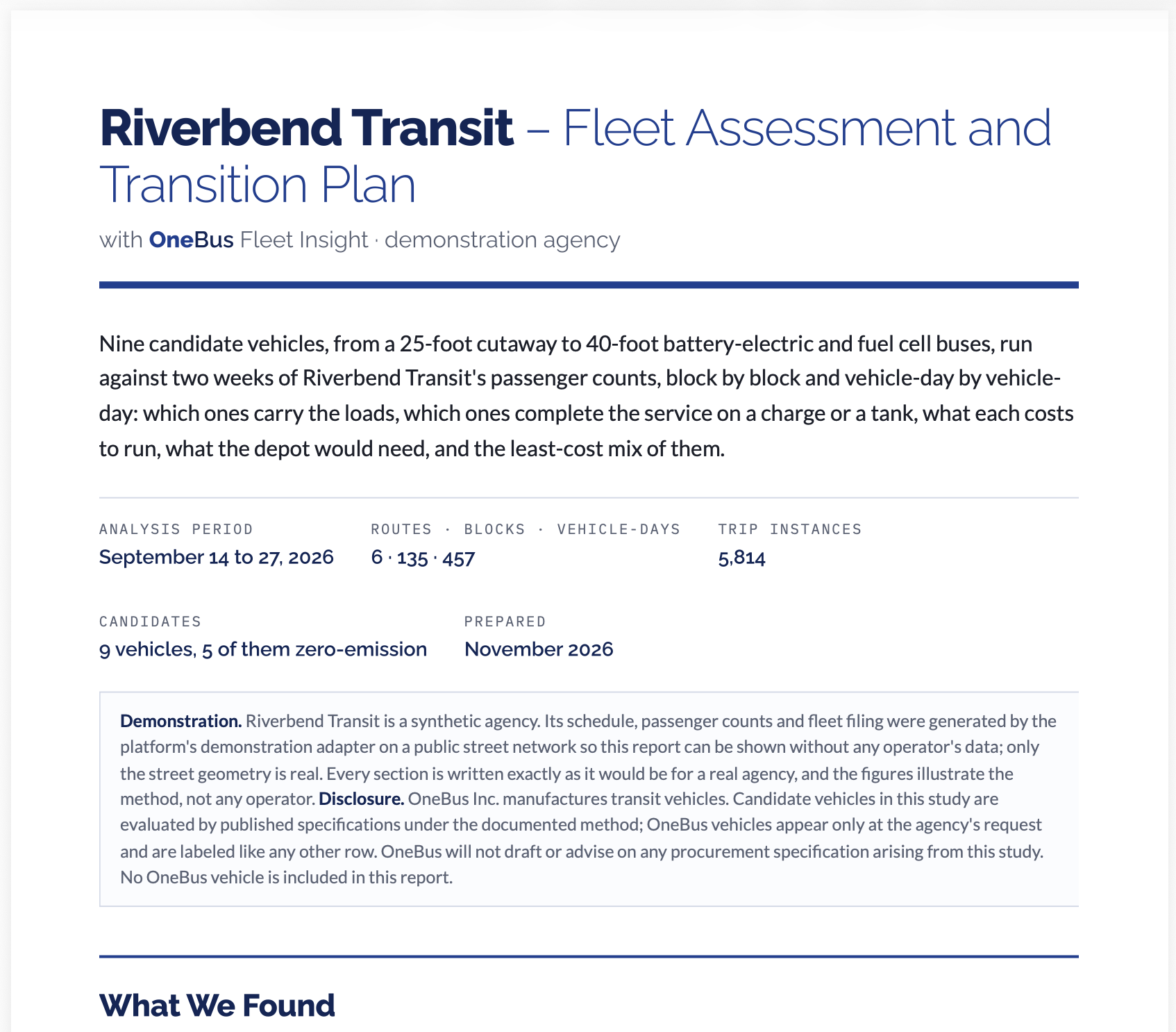
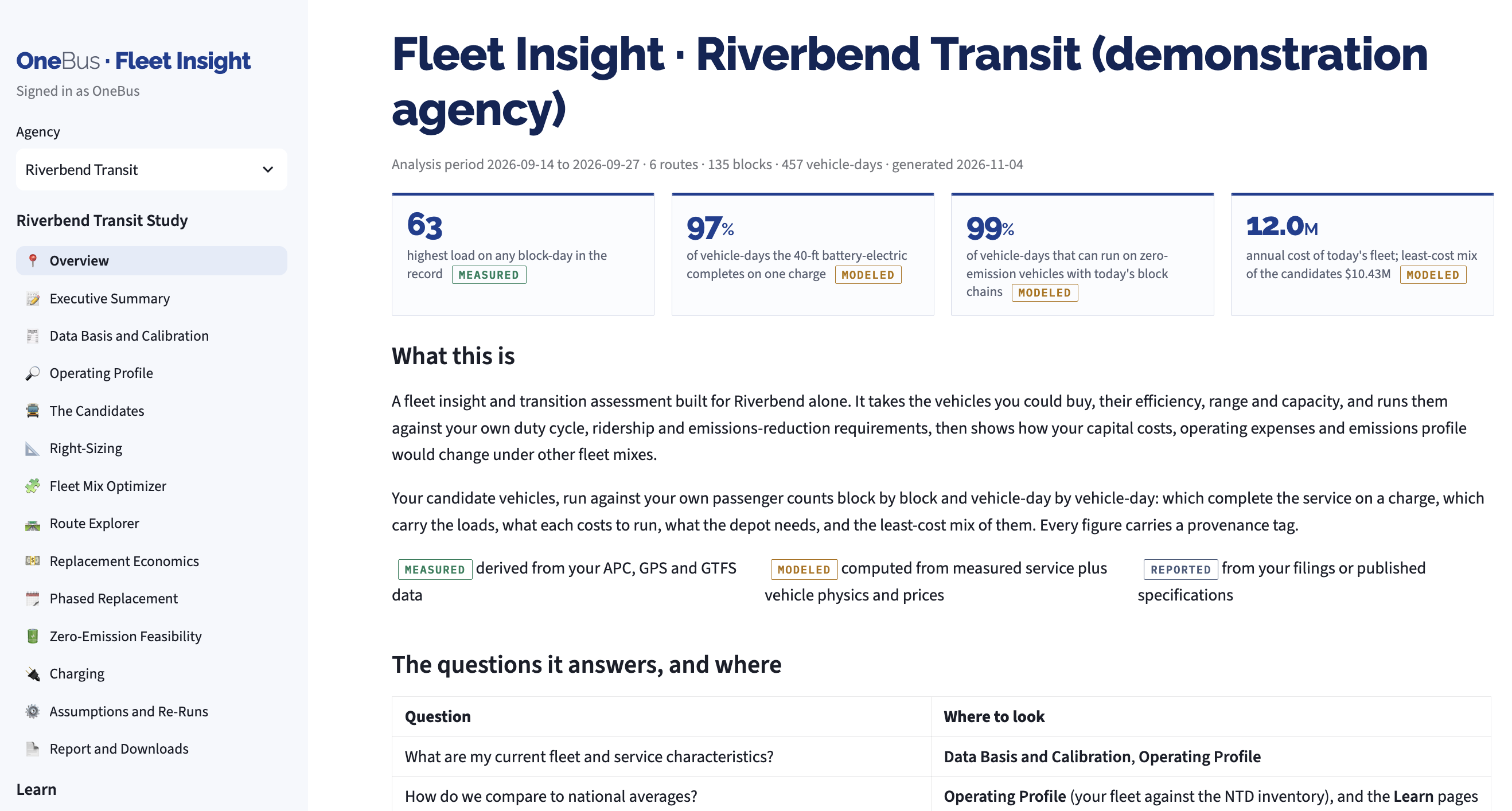
Riverbend Transit is a demonstration agency built on real street geometry, with a fleet mix close to the national average. No customer data is in it. The application and report are the same ones a customer receives, so you can click through every page, every assumption, every provenance tag, and download the report.

We do build buses. Here is why
you can still trust the study.

OneBus Inc. is a transit vehicle manufacturer developing a next generation 29-foot bus designed exactly for the over-capacity this study measures. That is why the method exists, but we are aware it could be a percieved conflict of interest. We state it plainly and have built it in the architecture rather than in a footnote:

  • Fleet Insight compares vehicles from a published catalog using one calibrated model. There is no OneBus branch in the pipeline.
  • The OneBus vehicle appears in a study only when the agency adds it to the candidate list, and we invite you to. Until then, it is not there.
  • Every section carries a Measured, Modeled, or Reported tag, and every assumption is listed with its value and source, so your planner can check the work.
  • The vehicle-agnostic study and the OneBus pitch can reach different, but honest, answers. With only today's market vehicles in the catalog, the least-cost result is usually a mix. OneBus's position is that one right-sized vehicle, coupled where loads require it, captures those savings with one vehicle type. The study does not assume that; if you add OneBus, it is run through the same model, the same loading standard, and the same economics as every other vehicle, and you can see which holds on your own data.

Agencies that want to see how OneBus itself would perform on their service can request an independent OneBus Fleet Assessment Report at no charge. It is run on the same data and the same model and delivered separately, so the vehicle-agnostic study stands on its own.

Anyone who wants a consultant-grade transit fleet assessment and learning opportunity at a reasonable price on a short timeframe.

The only requirement is a stop-level passenger count data on fixed-route service. If you have that, the study fits.

Transit agencies

Small and mid-size agencies that report to NTD, have a Low-No or 5339 application, a procurement, or a state zero-emission reporting deadline ahead.

University transit systems

Campus fleets with heavy over-capacity outside class changes and a climate commitment that needs a fleet plan behind it. If your vendor exports counts, the study runs.

Airport landside shuttles

Parking, rental car, employee, and inter-terminal fleets on fixed loops at predictable headways. Where APC is not installed, a modified intake using AVL plus counts is available.

Twenty-five years of
advanced vehicle programs.

Every study is run, read, and validated by Jason Hanlin, President and Co-Founder of OneBus. His career spans advanced technology vehicle development and commercialization, hydrogen and fuel cell programs, battery-electric vehicles, and technical program management, including fleet work at Delta Air Lines and the Center for Transportation and the Environment (CTE). The study brings that built-in expertise and a method you can audit.

The engine under Fleet Insight is the same one that powers the OneBus Network Management Platform, which plans day-ahead dispatch for OneBus fleets. The calibration, the agency adapters, and the vehicle-day modeling behind every study are core to OneBus's own product, not a side project.

Start with a
30-minute call.

Tell us about your fleet and the decision in front of you. We will walk you through the demonstration study, confirm what you can export, and send a one-page data request and a fixed-price proposal the same day. Work begins when the export and purchase order are in hand, and your agencies platform is delivered in days.

A limited Founding Study program is open to the first agencies, universities, and airports to engage, priced to fit under most micro-purchase thresholds and general manager signature authorities.

Prefer email? Write to onebususa@gmail.com.

Submitting opens a pre-filled email to the OneBus team from your mail client. No data is stored on this site.